Detention Pond Construction Company in Dallas: Scope, Coordination, and Contractor Selection
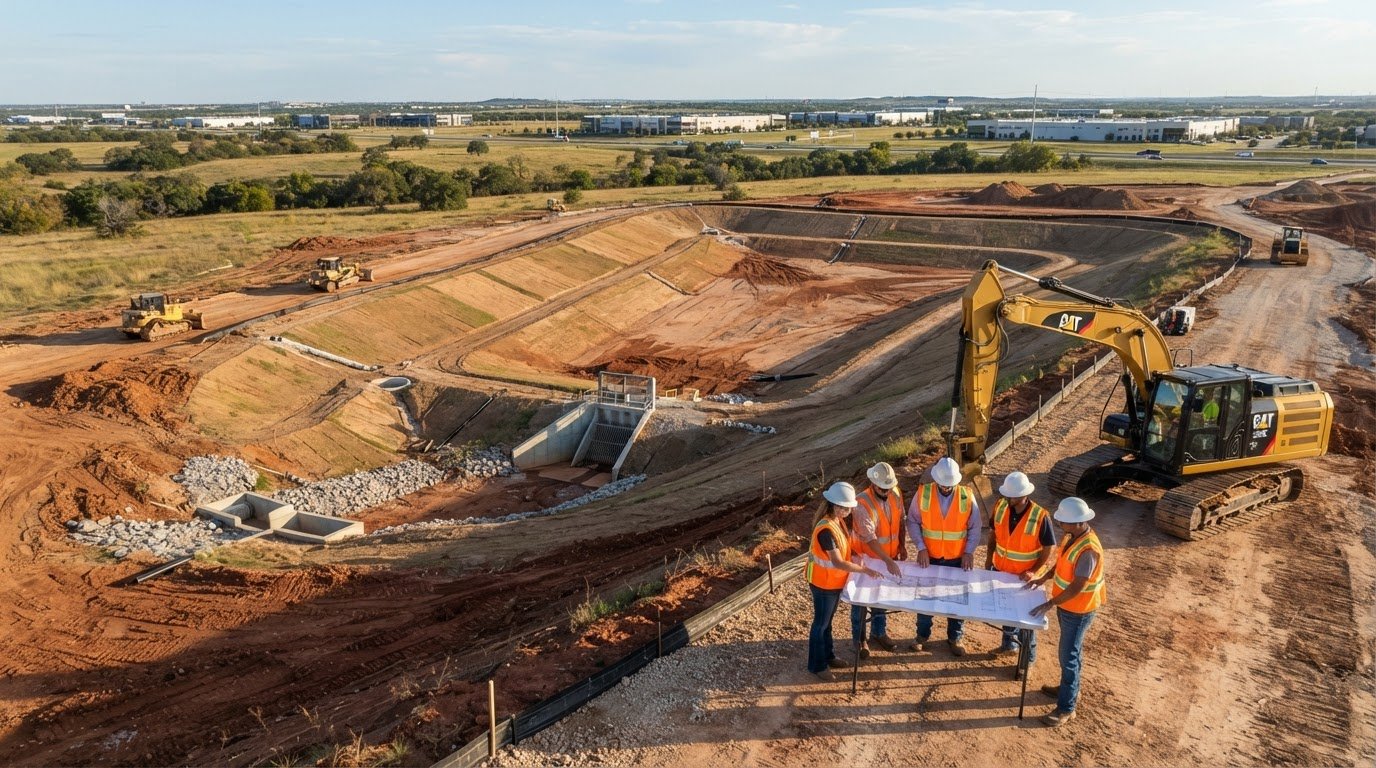
A detention pond can be excavated to plan and still create problems for a site if its work isn’t coordinated with surrounding earthwork and civil scopes. That’s why choosing a detention pond construction company Dallas project teams can coordinate with involves more than comparing proposals. You’ll want to understand what the contractor performs directly and how pond work connects with the broader project.
It’s reasonable to seek clarity before requesting a proposal. Pond construction may involve interfaces with excavation, grading, and other site work, but the contractor’s actual scope should be confirmed rather than assumed. Clear responsibilities help project teams identify questions early and assess whether a contractor is a suitable fit.
This article explains how to define the pond scope, identify coordination points, and compare contractors using practical, documented criteria. It also outlines how Born Integrated Construction’s listed offerings in detention ponds, mass soil excavation, and earthwork may fit into a Dallas-area civil construction discussion, while distinguishing construction scope from design, permitting, and other responsibilities that should be verified with the project team.
Key Takeaways
- Separate pond construction responsibilities from design work so the project scope is clear before proposals are requested.
- Identify handoffs among grading, drainage, utilities, and pond work to support coordinated site development.
- Assess a detention pond construction company Dallas project teams are considering using documented scope, relevant experience, safety practices, and communication.
- Prepare project documents and confirm jurisdiction-specific requirements with the appropriate professionals before evaluating contractors.
- Born Integrated Construction lists detention ponds, mass soil excavation, earthwork, and civil site work; confirm project fit and responsibilities against the plans.
What a Dallas Detention Pond Construction Company Can Contribute to Site Development
A developer needs a detention pond to function as part of the completed site, not as an isolated excavation. Its location and construction must fit the project’s plans and coordinate with adjacent grading, drainage, access, and other civil work. Selecting a detention pond construction company Dallas project teams can work with starts with understanding the contractor’s defined role.
Detention pond construction is the physical work required to build a stormwater basin according to the project’s plans and assigned scope. A Detention basin temporarily stores stormwater to help mitigate flooding. That plain-language definition describes the feature, not the contractor’s full responsibility. Design decisions and construction execution are distinct: confirm who is responsible for the design and who will carry out each part of the work.
Excavation and earthwork may connect the pond scope to site preparation and grading. Drainage work and other civil scopes can create additional handoffs. The project documents should establish where those responsibilities begin and end rather than leaving teams to infer them in the field.
What work may fall within detention pond construction?
Depending on the project and contract, possible construction activities may include excavation, earthwork, and site preparation. The plans and contract documents determine the actual scope. Confirm whether design, structures, stabilization, and finish work are included, assigned to another contractor, or handled separately. A listed service alone doesn’t establish which specific activities a contractor will perform on a particular job.
Why Dallas project teams should define scope early
Early scope alignment gives the project team an opportunity to identify interfaces before work begins. Confirm the pond’s location, site access, construction sequence, and adjacent work requirements. Clarify how pond activities relate to grading, drainage, utilities, and other contracted civil work, including who is responsible for each handoff. Project-specific plans and documents should guide those decisions.
Use a scope review to establish the project discussion:
- Identify the plans and contract documents that govern the pond work.
- List the activities included in the contractor’s proposed scope and the items that remain elsewhere.
- Confirm access, sequencing, and interfaces with adjacent site work.
- Ask who holds design responsibility and which project details still require confirmation.
Born Integrated Construction lists detention ponds, mass soil excavation, and earthwork among its offerings, alongside civil site work. These capabilities may be relevant to a coordinated site-development scope, but the company’s specific responsibilities depend on the project plans, location, and confirmed agreement. A clear scope helps the team evaluate fit without assuming that related services are automatically included.
How Pond Excavation and Civil Site Work Fit Together on Dallas Projects
Pond work is one part of a larger site sequence. Before excavation begins, the project team needs to understand how the pond area relates to access, existing site conditions, grading, drainage, utilities, and other contracted work. The order of activities depends on the approved project documents and site conditions, so teams should coordinate the sequence rather than assume a standard progression.
Coordinated earthwork sequencing matters because each handoff affects how the next part of the site can proceed. For example, pond excavation may depend on access being available, while nearby grading or utility work may share space or require coordination with the pond area. The project team should identify these dependencies and clarify who is responsible for each transition.
Where detention pond work meets earthwork and drainage
Born Integrated Construction lists mass soil excavation and earthwork among its offerings, along with detention ponds and civil site work. Those capabilities may be relevant to site preparation, but the company’s involvement in any particular activity must be confirmed in the project scope. Drainage connections and adjacent work are coordination points, not automatic inclusions. Construction execution should also remain distinct from engineering and design responsibilities, which need to be assigned and verified separately.
Questions to resolve before construction sequencing
Before establishing the sequence, review the approved project documents and confirm which plans govern each scope. Then identify site access, adjacent work, and the parties responsible for design, construction, and coordination. Ask whether utility work, grading activities, or other civil scopes depend on access to the pond area or on completion of another task. These conversations can expose handoffs that need clarification before crews begin work.
- Are the current project documents available to the contractors responsible for the affected scopes?
- Who controls access to the pond area, and how does that access relate to nearby work?
- Which contractor is responsible for each interface among pond excavation, grading, drainage, and utilities?
- What dependencies must be resolved before one scope can hand off work to another?
- Which decisions remain with the project designer or other qualified project professionals?
A contractor discussion is more productive when it is grounded in these documents and responsibilities. When evaluating a detention pond construction company Dallas project teams are considering, ask the contractor to identify the work it would perform directly and the interfaces that require coordination with others. Avoid relying on assumptions about schedule or outcome without project-specific information.
Born Integrated Construction’s construction project portfolio can provide general context about the company’s work. Confirm directly whether its listed offerings align with the plans, location, and responsibilities for the project under consideration.
How to Compare Detention Pond Construction Companies in Dallas
A useful comparison starts with evidence, not broad claims. A detention pond construction company Dallas project teams are considering should be able to explain its proposed scope in relation to the project documents, identify its coordination responsibilities, and clarify what falls outside its work. Compare contractors against the same criteria so important differences are visible before selection.
| Criterion | What to review | Questions to ask |
|---|---|---|
| Documented scope | Written inclusions, exclusions, assumptions, and requested clarifications | Which pond and earthwork activities would you perform directly? What is excluded? |
| Relevant experience | Verifiable examples, references, and descriptions of comparable work | Can you identify your responsibilities and the project context for each example? |
| Coordination | How the proposed work connects with grading, drainage, utilities, and adjacent scopes | Which handoffs would your team manage, and which require coordination with others? |
| Safety practices | The contractor’s stated practices and project-specific documentation, where applicable | What practices and records can you provide for consideration on this project? |
| Communication | How scope questions, clarifications, and coordination items will be documented | Who will address open items and keep the project team informed? |
What evidence should a contractor provide?
Request project references, descriptions of comparable pond work, and a clear account of the contractor’s role. Ask how it coordinated earthwork and related civil scopes on those projects, while distinguishing its own responsibilities from the work of designers and other contractors. A portfolio can offer context, but verify that examples are relevant before treating them as proof of pond-specific experience. If the construction project portfolio includes comparable work, review the details and confirm the scope directly. Born Integrated Construction identifies safety, integrity, efficiency, and quality as operating priorities. These are stated company priorities, not certifications, warranties, or independent verification of project performance.
How to compare proposals without relying on price alone
Review the scope documents side by side only after clarifying differences. A proposal that includes excavation but excludes related coordination is not directly equivalent to one that describes a broader role. Compare inclusions, exclusions, assumptions, assigned interfaces, and unresolved questions. If a proposal uses a general phrase such as “pond work,” ask for the specific activities covered and how they align with the project plans.
Record each contractor’s answers in the same comparison format. That makes gaps easier to identify and gives the project team a sound basis for follow-up. Resolve material scope differences before making a side-by-side assessment, and request verifiable references rather than assuming a contractor has completed comparable Dallas-area pond work.
What to Confirm Before Hiring a Dallas Detention Pond Contractor
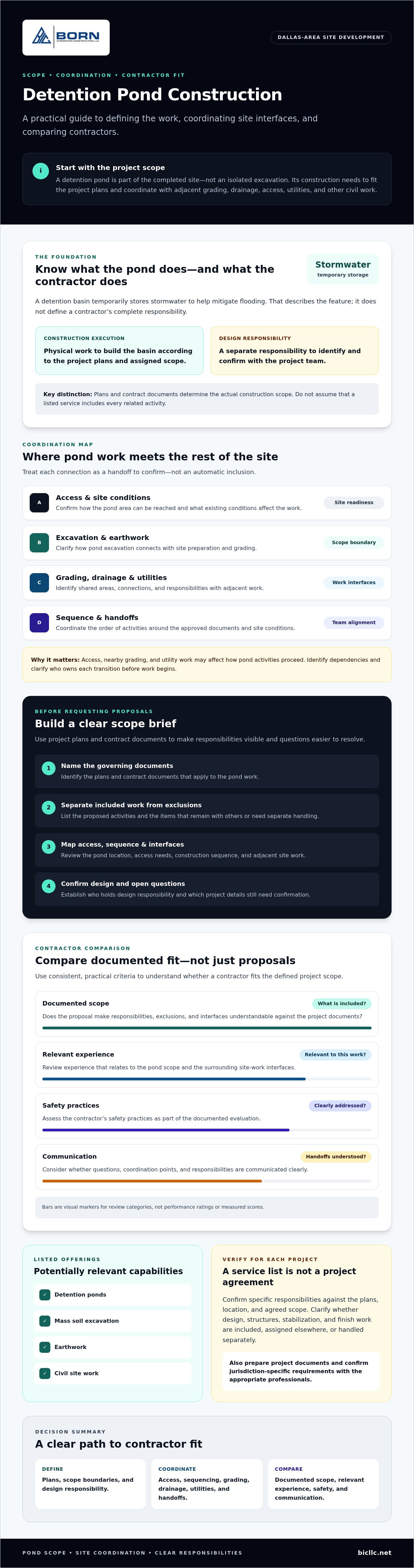
Before requesting a proposal, put the project information in order. A defined scope and clear responsibilities help a project team assess whether a contractor is suited to the work, without relying on assumptions about what “pond construction” includes. Use this sequence to prepare.
- Define the project scope. Identify the pond-related construction activities under consideration, the work assigned elsewhere, and any boundaries between scopes. Separate construction responsibilities from design and approval responsibilities.
- Assemble current documents. Gather the applicable project plans, specifications, site information, and existing scope descriptions. Note which documents are current and which details are still being confirmed.
- Confirm interfaces. Identify access needs, sequencing considerations, adjacent work, and the parties responsible for coordination. Clarify how pond activities relate to grading, drainage, utilities, and other civil scopes.
- Evaluate contractors. Compare each contractor’s written scope and clarifications against the project documents. Ask for verifiable references or examples relevant to the work, and confirm the contractor’s role in each example.
Documents and project details to organize
Keep the information organized so contractors are responding to a consistent understanding of the project. Along with plans and specifications, identify site access constraints, known scope boundaries, project contacts, and the professionals responsible for design and approvals. Maintain a separate list of open questions. Mark unresolved items for confirmation instead of treating an assumption as an established requirement.
This preparation also helps distinguish what a contractor proposes to perform directly from work assigned to designers, other contractors, or project stakeholders. Ask who will clarify an open interface and how decisions will be documented before construction begins.
Dallas-area requirements and contractor responsibilities
Confirm the site’s governing jurisdiction rather than assuming that a Dallas mailing address places the project within the City of Dallas. Applicable stormwater, permitting, and environmental requirements can depend on the location and project circumstances. Verify them with qualified local sources and the professionals responsible for the project. A contractor’s construction scope should not be treated as confirmation that design, permitting, or approvals are included.
Before mobilization, make sure the relevant parties understand the confirmed documents, access arrangements, work sequence, and their respective responsibilities. If requirements or interfaces remain open, identify who must resolve them and when they need to be addressed. This gives the team a clearer basis for evaluating a detention pond construction company Dallas project and preparing a coordinated discussion.
Born Integrated Construction lists detention ponds, mass soil excavation, earthwork, and civil site work among its offerings. To learn more about the company, review Born Integrated Construction’s company background, then confirm directly whether its scope aligns with the plans and responsibilities for your project.
Discuss Dallas Detention Pond Construction with Born Integrated Construction
Born Integrated Construction lists detention ponds, mass soil excavation, earthwork, and civil site work among its offerings. This range may be relevant when a project requires pond construction to connect with broader site work. The company also performs concrete construction, which may matter where concrete is part of the documented project scope. Each activity should be confirmed against the plans and the contractor’s proposed responsibilities.
Where Born Integrated Construction may fit your project
Start with the work your project actually needs. If the scope includes detention pond construction alongside mass excavation or earthwork, ask which activities Born Integrated Construction can perform directly and how those activities would relate to other contracted scopes. Project fit and responsibilities depend on the site location, project plans, and confirmed scope. The available information does not establish pond design services, permitting responsibilities, or Dallas-area pond references, so verify those items rather than assuming them.
For additional context on the company’s background and stated operating principles, review its company background and operating principles. Use that information alongside project-specific documentation and direct scope confirmation when assessing contractor fit.
How to start a project conversation
A focused discussion begins with clear project information. Prepare the site location, current project stage, available plans or specifications, and a concise description of the construction scope you are considering. Note any known interfaces with earthwork or other civil work. Then ask which activities the company can perform, what falls outside its scope, and which responsibilities remain with designers or other project professionals.
This preparation helps both sides discuss the actual work rather than rely on general descriptions. It also gives the project team a practical basis for determining whether the company’s listed offerings align with the plans and site requirements. A contractor’s capabilities should be confirmed for the specific project before responsibilities are assigned.
If you’re evaluating a detention pond construction company Dallas project teams may consider, bring your plans, location, and scope questions into the conversation. Contact Born Integrated Construction to discuss your project scope and clarify whether its listed construction offerings align with the work you need.
Move Forward with a Clearly Defined Project Scope
A sound contractor decision begins with a clear understanding of the work. Define the pond construction scope, document interfaces with other site work, and compare contractors on written responsibilities, relevant evidence, safety practices, and communication. Confirm project requirements with the professionals responsible for the site rather than relying on assumptions.
Born Integrated Construction lists detention ponds, mass soil excavation, earthwork, and civil site work among its offerings. The company also identifies safety, integrity, efficiency, and quality as priorities that guide its work. Whether it fits your project depends on the plans, location, and responsibilities confirmed for the specific scope.
If you’re assessing a detention pond construction company Dallas project teams can coordinate with, bring your site information and scope questions to the discussion. Discuss your Dallas-area project scope with Born Integrated Construction and take the next step with a clearer basis for planning.
Frequently Asked Questions
What does a detention pond construction company do?
A detention pond construction company performs construction work assigned to it for a project’s pond scope. Depending on the plans and contract, that work may connect with excavation, earthwork, or other civil site work. The contractor’s responsibilities should be distinguished from design, approvals, and work assigned to other parties. Review the project documents and confirm specific inclusions and exclusions before assuming a particular activity is part of the contractor’s scope.
How do I choose a detention pond contractor in Dallas?
Choose by comparing documented scope, relevant experience, coordination approach, safety practices, and communication. When evaluating a detention pond construction company Dallas project teams can work with, request verifiable examples of comparable pond work and clarify the contractor’s role in each. Compare written inclusions, exclusions, assumptions, and open questions against the same project documents. Confirm the site jurisdiction and have qualified project professionals verify applicable requirements.
Can one contractor handle detention pond excavation and other site work?
One contractor may be able to take on multiple related scopes if those services are offered and the project agreement clearly assigns them. Born Integrated Construction lists detention ponds, mass soil excavation, earthwork, and civil site work among its offerings. Confirm which activities it can perform on your project, how they relate to grading, drainage, or utility work, and which responsibilities remain with other contractors or project professionals.
What should I provide when requesting a detention pond construction proposal?
Provide the site location, current project plans and specifications, project stage, and a description of the construction scope you want priced. Include known access conditions, scope boundaries, adjacent work, and any available information about sequencing or responsible parties. Identify open questions rather than presenting assumptions as confirmed requirements. These details help a contractor review the requested work and state its proposed inclusions, exclusions, and coordination responsibilities clearly.
Do I need a permit to build a detention pond in Dallas?
Permit and other project requirements depend on the site’s jurisdiction and project details, so confirm them before construction planning proceeds. First establish whether the property is within the City of Dallas or another authority’s jurisdiction. Then consult qualified local sources and the professionals responsible for the project to verify applicable stormwater, permitting, and environmental requirements. A construction contractor’s scope should not be treated as confirmation that approvals are covered.
How do detention ponds fit into commercial site development?
Detention ponds are one component of a broader site plan and may interface with excavation, earthwork, grading, drainage, utilities, access, and other civil scopes. Their construction responsibilities and sequence should be coordinated with the plans and assigned scopes. Identify who handles each handoff and who is responsible for design or approvals. This coordination gives the project team a clearer basis for organizing pond work alongside other site activities.
Does Born Integrated Construction offer detention pond construction in Dallas?
Yes. Born Integrated Construction lists detention ponds as an offering and serves Dallas and other Texas markets, including Houston, Austin, San Antonio, Fort Worth, San Marcos, New Braunfels, Boerne, Beaumont, Conroe, The Woodlands, and Arlington. The company also lists mass soil excavation, earthwork, and civil site work. Confirm which activities it can perform directly for your project, since responsibilities depend on the plans, location, and agreed scope.