Paving Stabilization Contractor in Fort Worth: A Commercial Buyer’s Guide

What if the lowest bid is not the clearest plan for the ground beneath your pavement? Choosing a paving stabilization contractor Fort Worth commercial buyers can rely on means looking beyond price and understanding how the proposed work responds to site conditions. In North Texas, moisture-sensitive clay can expand and contract, making careful ground preparation an important part of paving planning.
It’s reasonable to want confidence that the stabilization approach fits your project and that unclear scope or coordination gaps won’t interrupt paving work. Bids can be difficult to compare when they describe different assumptions, methods, or responsibilities.
This guide explains how to assess contractor qualifications and project fit, identify essential details in a stabilization scope, and coordinate site preparation with concrete paving. You’ll also learn what to clarify about site assessment, work sequencing, and the handoff between stabilization and paving teams. The goal is a more informed selection process for your Fort Worth commercial project.
Key Takeaways
- Match the stabilization approach to the project documents and site-specific assessment rather than relying on a generic proposal.
- Compare paving stabilization contractors by scope alignment, relevant experience, communication, safety approach, and coordination.
- Review proposals for documented evidence, unanswered questions, and assumptions so you can identify gaps before award.
- Before work begins, confirm the awarded scope, decision contacts, documentation, and responsibilities for coordinating stabilization with paving.
- Born Integrated Construction lists both paving stabilization and concrete paving among its offerings and emphasizes safety, integrity, efficiency, quality, and customer relationships.
What Fort Worth commercial buyers should expect from paving stabilization
Paving stabilization is site preparation that addresses the ground beneath a pavement system according to the project design and site conditions. The term can describe different physical, chemical, or mechanical approaches, as outlined in this broad overview of soil stabilization. It does not identify one universal method or establish what a particular project requires. The plans, specifications, and site assessment should guide the scope.
For commercial buyers, that distinction matters. Paving stabilization supports the specified pavement system. It is not a catch-all term for repairing a residential driveway or installing asphalt paving. Before selecting a paving stabilization contractor, Fort Worth project teams should establish what work is needed, where the contractor’s responsibilities begin and end, and how the prepared area will be accepted for the next phase.
How stabilization fits into a commercial paving project
Stabilization generally falls within the ground-preparation phase, before the specified pavement work proceeds. The sequence and scope depend on project documents and actual site conditions. Geotechnical information and design direction, when available, should inform method selection rather than assumptions based on a project’s address or pavement type.
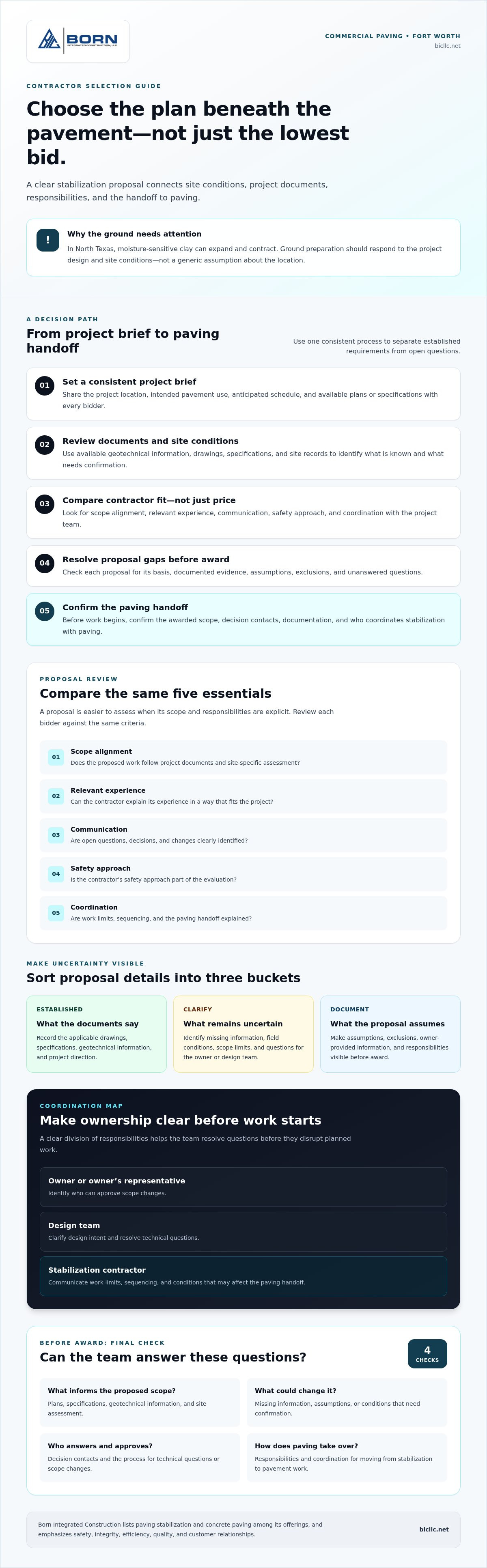
Coordination is essential. The owner or owner’s representative should identify who can approve scope changes. The design team should clarify design intent and resolve technical questions. The contractor should communicate work limits, sequencing, and any conditions that may affect the paving handoff. A clear division of responsibilities helps the team address questions before they disrupt planned work.
What Fort Worth buyers should clarify before requesting proposals
Give bidders a consistent project brief so their proposals can be compared on the same basis. Include the Fort Worth project location, intended pavement use, anticipated schedule, and available plans or specifications. Ask bidders to identify any additional information they need to assess the site and define their proposed scope.
- Which drawings, specifications, or geotechnical information will inform the proposal?
- What site conditions or missing information could change the proposed scope?
- How will stabilization work coordinate with the pavement contractor and design team?
- What assumptions, exclusions, or owner-provided information should be documented?
Do not treat a proposal as confirmation that every project requirement has been addressed. Verify applicable specifications, authority requirements, and site conditions with the project team before award. A qualified paving stabilization contractor Fort Worth buyers evaluate should be able to explain the basis of its proposal, identify open questions, and define how its work connects to the next phase.
How a paving stabilization contractor assesses scope and site conditions
A dependable assessment follows a traceable sequence: review available documents, assess the site, clarify the scope, coordinate with the project team, and document decisions. Each step helps distinguish what is established from what still needs investigation or design direction. A site observation may identify a visible condition, for example, but it does not by itself determine the appropriate treatment.
Project documents guide stabilization decisions because they communicate the pavement design intent and the requirements the work must support. Geotechnical information and direction from design professionals should inform method selection. If those inputs are missing, incomplete, or inconsistent with observed conditions, the contractor should identify the uncertainty and seek clarification rather than assume a specific solution.
What information should inform the stabilization plan?
Start with the available geotechnical reports, drawings, specifications, and relevant site records. The contractor can then identify what the documents establish, what needs confirmation, and which questions require input from the owner or design professionals. For instance, a bidder may need clarification about the limits of work, the pavement system being supported, or how an unexpected field condition should be reviewed.
Method selection should follow verified project direction. A proposal should not prescribe lime, cement, or another treatment solely on the basis of a general expectation about local soils. Where the design basis or site information does not support a clear recommendation, document the open item for review by the appropriate project professional.
How should the contractor coordinate with paving teams?
Before work begins, establish the interface between stabilization and the planned concrete paving scope. Confirm work limits, sequence, site access, and which party is responsible for each handoff. The team should also agree on who receives field questions, who has authority to make decisions, and how proposed scope changes will be reviewed and recorded.
These details give the paving team a defined point of coordination instead of leaving readiness or responsibility open to interpretation. For a paving stabilization contractor Fort Worth project teams are assessing, clear communication about the handoff is as important as a written description of the work.
A practical assessment record can summarize the documents reviewed, site observations, assumptions, unresolved questions, assigned follow-up, and approved scope clarifications. Keep observations separate from conclusions that require engineering direction. This record gives the owner and design team a shared reference as the work advances.
Buyers can also review Born Integrated Construction’s documented projects as part of understanding its broader construction experience, while confirming project-specific capabilities and scope directly with the team.
How to compare Fort Worth paving stabilization contractors
Compare proposals against the same project documents, not just against one another’s totals. A useful evaluation considers scope alignment, relevant experience, communication, safety approach, and coordination with the paving team. A bid that clearly identifies its assumptions and open questions may provide a sounder basis for comparison than one that leaves responsibilities unstated.
For each paving stabilization contractor Fort Worth buyers consider, review three kinds of information: what is documented, what remains unanswered, and what appears to be assumed. This simple framework helps distinguish a clear offer from a scope gap that needs resolution.
| Review area | Documented evidence | Unanswered questions | Assumptions to flag |
|---|---|---|---|
| Scope alignment | Work limits and included tasks tied to the project documents | Are any project requirements still awaiting clarification? | Unstated exclusions or assumed site conditions |
| Relevant experience | Project descriptions and the contractor’s specific role | Can references confirm the work and coordination involved? | General experience presented as equivalent to this project |
| Communication and coordination | Named contacts and a described process for field questions | Who can authorize a change or provide design direction? | Responsibilities left between contractor and paving team |
| Safety approach | Project-relevant safety information provided by the bidder | What additional project-specific details should be reviewed? | Broad statements without supporting explanation |
What evidence should a commercial buyer request?
Ask each bidder for relevant project descriptions and clarify the contractor’s role, such as whether its work included stabilization, concrete paving, or coordination between those scopes. Verify references and examples directly with the contractor. A project list alone does not establish what work was performed. Born Integrated Construction’s commercial concrete paving project examples can serve as review material, but should not be treated as proof of stabilization experience. Ask about the company’s background and operating principles as part of your review.
How can you identify gaps in a bid?
Compare inclusions, exclusions, assumptions, and stated interfaces line by line. Ask bidders to explain differences using the same drawings and specifications, then record the answers so proposals can be evaluated consistently.
Flag unspecified testing, acceptance criteria, or responsibility for resolving field conditions. These items may require clarification from the owner or design professionals. Do not treat a bidder’s silence as approval or as a project requirement. A disciplined comparison makes the selection basis clearer and helps the team address material gaps before award.
What to confirm before awarding a Fort Worth stabilization project
Before issuing an award, reconcile the proposal with the current drawings, specifications, and written clarifications. Confirm that the contractor’s scope describes the intended work limits and identifies exclusions or assumptions. If the documents conflict, obtain direction from the responsible design professional rather than relying on an informal interpretation.
Award readiness also depends on clear project roles. Identify the contractor’s day-to-day contact, who can approve decisions or scope changes, who provides design direction, and how records will be shared with the owner and other trades. Review sequencing, site access, adjacent work, and schedule dependencies with the project team. These items help establish a coordinated start, but they do not guarantee a particular schedule or outcome.
Which scope details should be settled before mobilization?
Put the agreed scope in writing, including its limits, the documents it references, exclusions, and any assumptions that remain open. Confirm with the project team how project-specific testing and acceptance requirements will be addressed, and identify who is responsible for arranging, reviewing, and documenting them. If requirements are absent or unclear, seek clarification before work proceeds.
- Are the proposal and award based on the same current drawings and specifications?
- Are exclusions and unresolved assumptions recorded and assigned for follow-up?
- Who will respond if field conditions differ from the information provided?
- Have conflicts between documents been referred to the responsible design professional?
These checks give the owner and contractor a shared reference. They also reduce the risk that differing interpretations surface only after mobilization.
How can buyers manage coordination and change risk?
Agree on a process for submitting field questions, obtaining approvals, and recording scope changes. Clarify who can authorize a change, how the decision will reach affected teams, and which written record becomes part of the project file. Keep design decisions with the designated design professional. A contractor’s observation should not be mistaken for approval to revise the design.
Coordinate stabilization activities with concrete paving and other site work, including work interfaces, access needs, and the planned handoff. Regional paving projects may involve different site conditions and project requirements, so use the Fort Worth project’s own documents and team direction to resolve local questions.
Before award, buyers evaluating a paving stabilization contractor Fort Worth project should confirm that responsibilities, documentation, and decision paths are understood by the parties involved. Ask Born Integrated Construction about its background and operating principles as part of your evaluation.
Selecting Born Integrated Construction for Fort Worth paving stabilization
Born Integrated Construction lists both concrete paving and paving stabilization among its offerings, alongside civil site work and other concrete construction services. That combination may be relevant when a project team is considering related scopes together. The right fit still depends on the project documents, required qualifications, site conditions, and confirmation of current service availability for the specific Fort Worth project.
The company emphasizes safety, integrity, efficiency, quality, and attentive customer relationships. Buyers can assess how those principles translate into project communication by asking how scope, field questions, and coordination responsibilities will be handled. Clear answers help establish whether the proposed working relationship suits the project’s requirements.
When an integrated concrete and stabilization contractor may fit
Discussing concrete paving and stabilization with one construction partner may help the team clarify scope interfaces and handoffs. It does not automatically make one contractor the right choice. Compare the proposed work with the design direction, verify relevant qualifications and project experience, and confirm the contractor’s availability and ability to address the specific scope. Do not assume every stabilization method or project type is offered.
What to include in an initial project conversation
Provide the project location in Fort Worth, current plans and specifications, schedule needs, and the scope being considered. Identify known site questions, related concrete paving work, and any coordination requirements. Ask the team to confirm whether the project is within its service area and whether the requested scope aligns with its current capabilities before procurement proceeds.
- Share the current project documents and identify any revisions or unresolved conflicts.
- Describe known site conditions and questions that may need design-team direction.
- Define the requested stabilization and concrete paving scopes, including their interfaces.
- Ask what additional information is needed to evaluate fit and prepare a proposal.
These early clarifications create a more useful basis for discussion without presuming a particular method, result, or schedule. They also give the owner and project team an opportunity to resolve questions before making a commitment.
For a closer look at the company’s documented work, review Born Integrated Construction’s project examples. If the listed services appear relevant, use the project details as a starting point for a conversation about scope, site conditions, coordination needs, and next steps.
Set a clear foundation for your Fort Worth project
Selecting a paving stabilization contractor Fort Worth buyers can depend on starts with a clear understanding of site conditions, project documents, scope, and coordination responsibilities. Compare proposals based on what they include, what remains unresolved, and how the work connects to concrete paving. Before award, confirm that the contractor’s scope matches current project requirements and that decision-making and documentation processes are understood.
Born Integrated Construction lists concrete paving as its primary service and paving stabilization among its offerings. The company emphasizes safety, integrity, efficiency, quality, and attentive customer relationships. It serves Texas markets including Houston, Austin, San Antonio, Dallas, Fort Worth, San Marcos, New Braunfels, Boerne, Beaumont, Conroe, the Woodlands, and Arlington. Buyers can use an initial discussion to confirm whether the project’s location, requirements, and requested scope are a fit, without assuming a particular method or availability.
Bring your current plans, specifications, schedule needs, and known site questions to the conversation. Discuss your Fort Worth paving stabilization project with Born Integrated Construction and take the next step with a clear basis for planning.
Frequently Asked Questions
Is paving stabilization necessary before every commercial concrete paving project?
No single answer applies to every project. Whether stabilization is needed, and what its scope should be, depends on the project documents, site conditions, and design direction. Review available geotechnical information and consult the responsible design professional if requirements are unclear or documents conflict. For commercial paving in Fort Worth, avoid assuming stabilization is always required or unnecessary before the project team evaluates the specific site and pavement design.
What does a paving stabilization contractor do?
A paving stabilization contractor carries out the stabilization scope established for a project and coordinates that work with site preparation and paving activities. The specific methods, work limits, and responsibilities depend on the contract documents and site requirements. Confirm what the contractor is responsible for, how field questions will be handled, and where its work hands off to the paving team. Do not assume the contractor also provides design or engineering services unless that role is explicitly established.
How do I choose a paving stabilization contractor in Fort Worth?
Compare scope alignment, relevant documented experience, communication practices, safety approach, and coordination with the paving team. Give each bidder the same project information and ask consistent questions about inclusions, exclusions, assumptions, and open items. Verify references and project examples directly with each contractor, including the contractor’s specific role. Confirm that a paving stabilization contractor Fort Worth project teams are considering has current service availability and is a suitable fit for the project. Do not assume location guarantees capability or timing.
What information should I provide when requesting a paving stabilization proposal?
Share the Fort Worth project location, intended use, available drawings and specifications, geotechnical reports, schedule needs, and known site constraints. This gives bidders a common basis to identify questions and state assumptions. If information is incomplete, label unknowns clearly instead of presenting them as confirmed conditions. Ask the appropriate project professional for direction where needed, and treat a proposal as preliminary until its basis, open items, and scope are understood.
Should a paving stabilization contractor select the treatment method?
The method should follow project specifications, site assessment, and direction from qualified design professionals as applicable. A contractor can describe its proposed scope, explain the basis for its approach, and identify missing information or questions for the design team. That does not establish independent design authority. If documents do not specify a method or provide enough direction, ask the responsible professional to clarify the project requirements before approving a treatment.
What should a paving stabilization proposal include?
Check that the proposal identifies its scope, referenced documents, assumptions, exclusions, coordination points, and process for addressing field questions. Any testing and acceptance requirements should align with the project documents, with responsibilities made clear. Compare proposals against the same drawings and specifications. If bidders differ or leave a responsibility undefined, request clarification in writing before award. A brief headline description alone may not show whether the proposed work matches the project’s requirements.
Can one contractor coordinate paving stabilization and concrete paving?
Yes, a buyer can ask whether a contractor is qualified and available to coordinate both scopes for the specific project. Born Integrated Construction lists concrete paving and paving stabilization among its offerings and serves Texas markets including Fort Worth, Houston, Austin, San Antonio, Dallas, Arlington, San Marcos, New Braunfels, Boerne, Beaumont, Conroe, and the Woodlands. Confirm current service fit, scope, responsibilities, and availability directly. A listed offering does not mean every project or method is suitable.